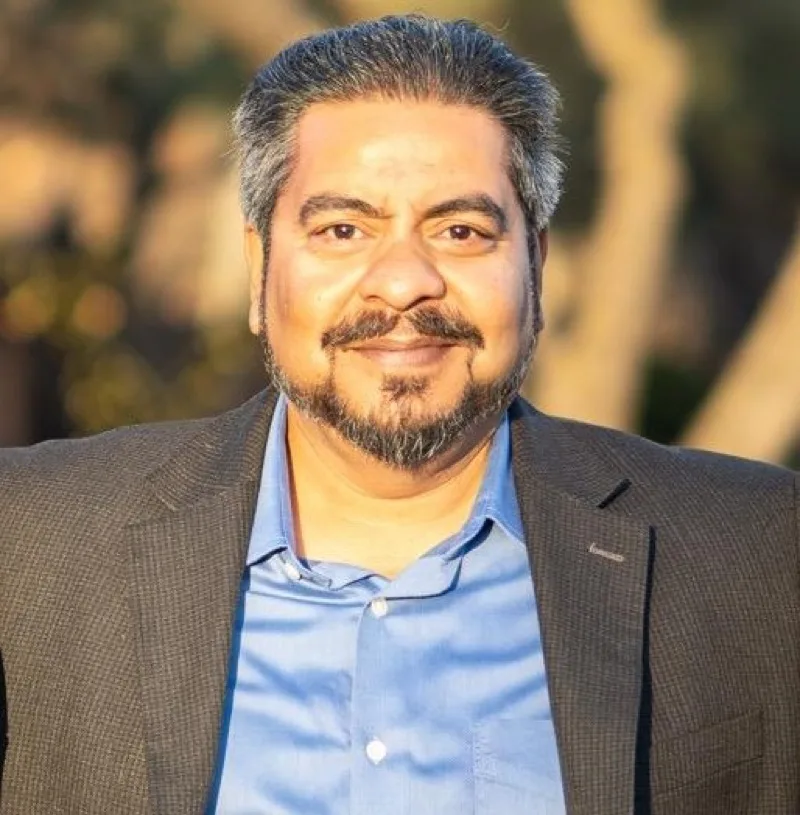
My life splits clean down the middle. Twenty-five years in Mumbai. Twenty-five in Alpharetta, Georgia. Same person, two continents, one through-line: an inability to leave things alone. Growing up, I cycled through three neighborhoods across three faiths — Hindu, Muslim, Christian, eight years in each — and came out the other side an atheist with the conviction that people are fundamentally the same once you strip away the things they argue about. That conviction didn't come from a book. It came from sharing walls with neighbors who prayed differently and cooked differently and celebrated differently, and realizing none of it changed how they treated the kid next door.
I didn't come to America for a career. I came for a girl named Archana. We joined the same company in India on the same day, spent six months in training together, and couldn't stand each other. I was the grinder — first to arrive, last to leave, always working. She made it look effortless. And every single test, without fail, she finished first. I finished second. It was infuriating. Somewhere between the rivalry and the late-night offshore shifts for a company called Alltel Wireless, the friction turned into friendship, and the friendship turned into something neither of us named. When she got the opportunity to move to Alpharetta, I was left in India staring at a hole in my life shaped exactly like her. I moved heaven and earth to follow. We both landed in the US in 2000. By 2004, we were married. Today, Archana is a Senior Director of Enterprise Architecture at Verizon — because of course she is. The woman who always finished first never stopped. I've made peace with second place. I married the smartest person in every room she walks into, and I've never looked back.
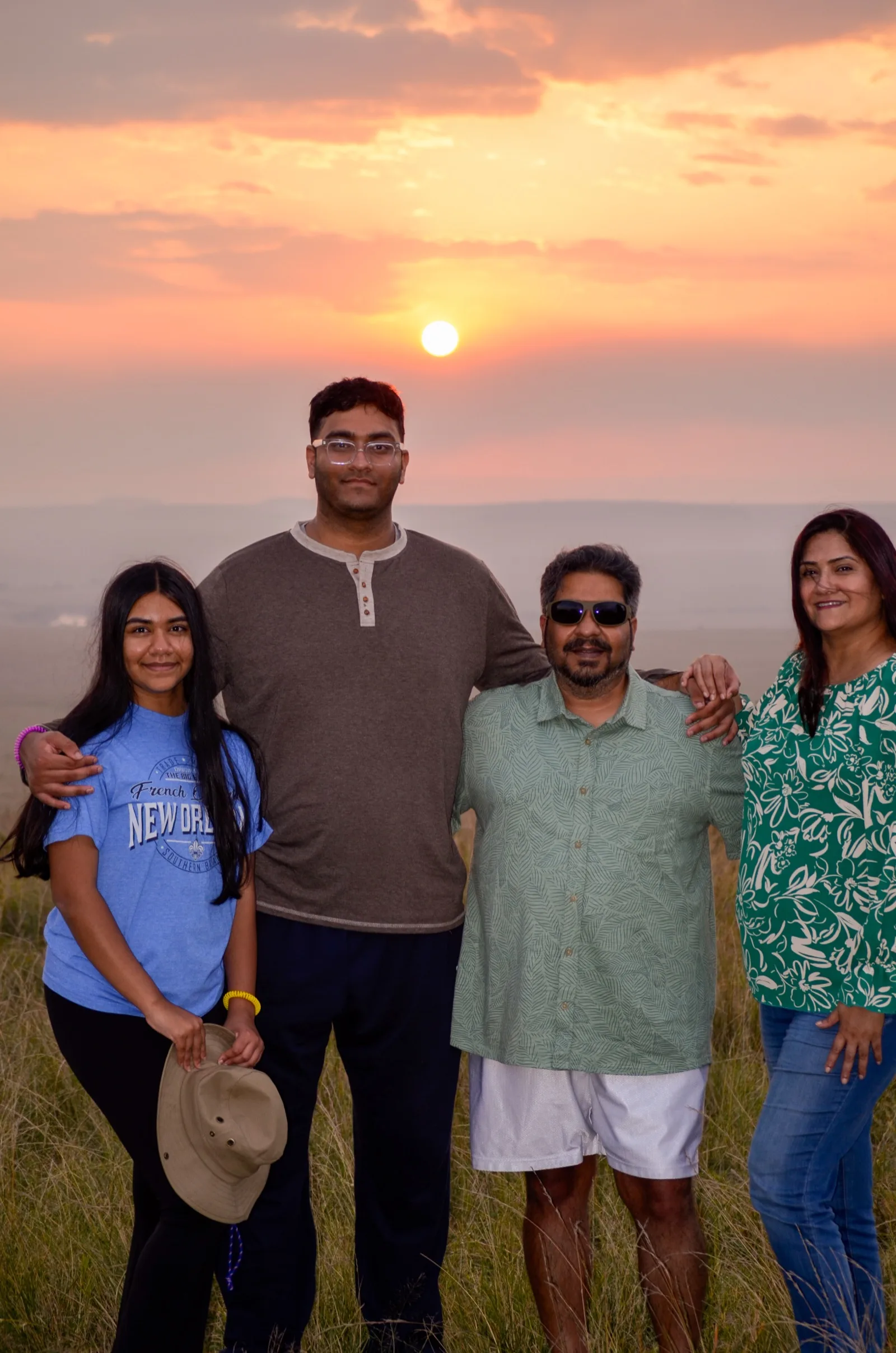
The Prabhu family. Kenya, July 2025. The reason everything else matters.
We have two kids who could not be more different. Dhruv, the firstborn — our "DEV baby," because we were essentially beta-testing our parenting on him — is twenty, studies computer science at Georgia Tech, and stands six foot seven. I'm five-six. His mother is five-ten. Nobody can explain the math. Dhruv grew tall early and absorbed the kind of attention that comes with towering over everyone in the room since middle school — not all of it kind. It never hardened him. He is one of the gentlest souls I've ever encountered. Patient, collegial, quietly devoted to the people he loves. He avoids confrontation, lives nocturnally, and will almost certainly end up in a role where his kindness is the thing that sets him apart. I don't worry about Dhruv's future. I look forward to watching it unfold.
Maanya is fifteen and operates on a completely different frequency. She is our sharpest edges refined into a single person — empathetic like me, precise like her mother, and opinionated in a way that would be exhausting if she weren't so consistently right. She has studied Kathak, the Indian classical dance form, since the age of six and will earn her certification in three years. She paints, draws, plays piano, and makes music — and volunteers almost none of it to the outside world. The talent is obvious; the performance is reluctant. She creates for herself. At fifteen, that kind of quiet self-possession is the thing that makes me — a man who builds loudly and ships constantly — stop and pay attention.
The 1100cc that almost killed me. Eighteen years and counting.
There is a motorcycle in my driveway that I've owned for eighteen years. It's an 1100cc cruiser — a machine I bought after riding a 100cc bike in India, not fully comprehending what an eleven-fold increase in power would feel like underneath me. I spent the first two years hanging on. Now it's where I go to disappear. Psytrance in the helmet, the north Georgia mountains ahead, no particular destination, no particular timeline. Just ride until the urge to turn back arrives. It's the closest thing I have to meditation, and I'd never call it that.
I play guitar — electric and acoustic, mostly 70s rock, mostly poorly, mostly not at all anymore. I stopped playing years ago for reasons I can't articulate, which probably means the reasons are obvious to everyone but me. When I did play, it was the only thing that made the noise in my head go quiet. My real instrument now is psychedelic trance piped through headphones at 2 AM while the rest of the house sleeps. Nobody in the family can tolerate it. It lives exclusively in my ears, and it turns me into a machine. Ten times the productivity, zero interruptions, the world reduced to code and bass and the hum of something being built.
My first American job was writing C for the billing system at Alltel Wireless, a regional carrier with a culture I still talk about like it was family — because it was. I spent eighteen years in telecom, first at Alltel, then at Verizon after the acquisition, running point-of-sale and customer care systems at a scale that taught me how enterprise software actually works when millions of people depend on it. It was a good run. And then in 2017, my father passed away.
Grief does strange things to an engineer's brain. Mine didn't shut down — it recalibrated. I started asking questions I'd been too comfortable to ask. Am I here because this is where I belong, or because this is where I landed? Are the skills I've built over two decades actually mine, or do they only work inside the walls of one industry? I needed to know. So I did the most disorienting thing I could think of — I left telecom entirely and went looking for an industry as far from wireless networks as I could find. I landed at Delta Dental of California. Dental insurance. About as far from cell towers as you can get. And something unexpected happened: I found Alltel again. Not the company — the culture. The same sense of family, the same people who genuinely care about the work and about each other. And the skills? Completely portable. Enterprise architecture is enterprise architecture. The domain changes. The problems don't. That was the answer I needed. Somewhere in the middle of all this, I went back to Georgia Tech and finished my Executive MBA — a dream I'd carried since 2000 but couldn't afford as a twenty-four-year-old immigrant on a contractor's salary. Eighteen years later, I walked into the same campus my son would eventually attend as an undergrad. Life has a sense of humor, and occasionally, a sense of justice.
I'm fifty. Stubborn, opinionated, unapologetic, and blunt. The alias is RealDesiMcCoy — a riff on the Hatfield-McCoy feud, because McCoy was stubborn and so am I. "Desi" is slang for someone of Indian origin. Put it together and you get the Real Indian McCoy — a guy who came to America chasing a woman, stayed for a quarter century, waited seventeen years for a piece of paper, built systems that run at enterprise scale, deleted every social platform that tried to own his attention, and now writes what he thinks on a website he built himself because nobody else was going to give him a stage.
If you've read this far, you're probably feeling one of two things. Either this isn't for you — and that's fine, not everything is. Or you're thinking: I want to be part of whatever this guy is doing. If it's the second one — good. The koolaid is working.